
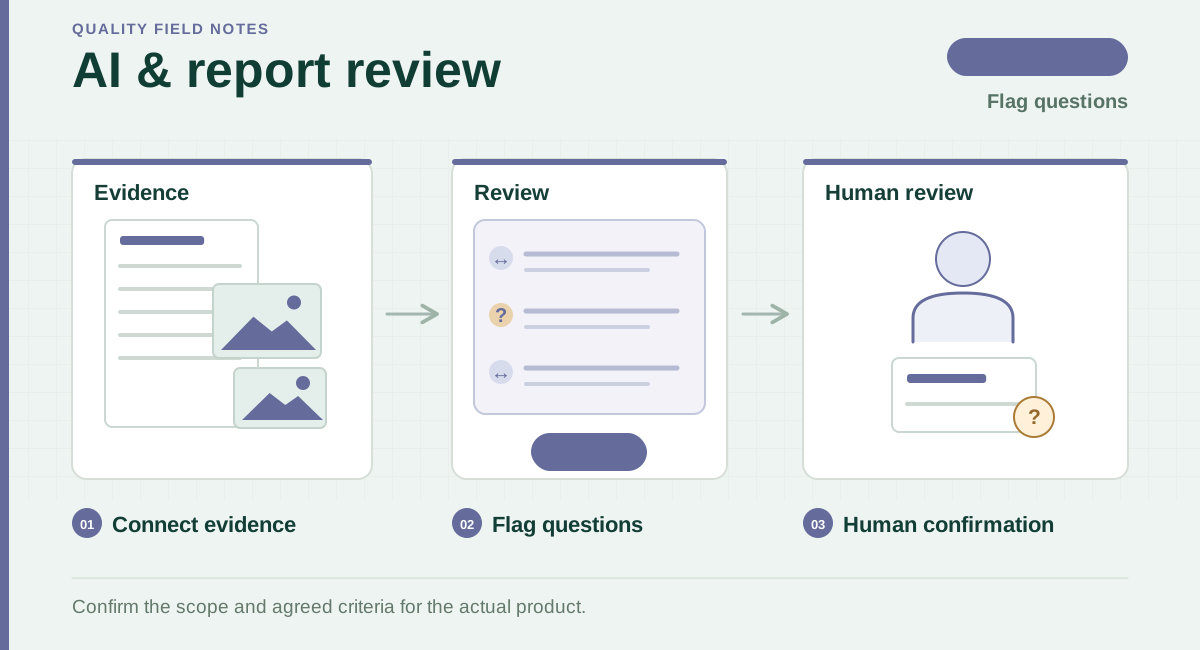
Read the diagram
- Connect evidence
Associate report fields, observations and supporting photos.
- Flag questions
Use checks to identify gaps and inconsistencies for review.
- Human confirmation
A responsible person verifies facts and decides the next action.
Three different jobs for AI
| Job | Useful result | Limit |
|---|---|---|
| Visual assistance | Flag an area in a photograph for closer review. | A photograph may not show function, dimensions or the whole lot. |
| Report checks | Locate inconsistent quantities, units, models or missing evidence. | An alert needs to be checked against the source requirement and record. |
| Report interpretation | Explain an issued report in clear language with evidence references. | An explanation does not change the approved report or its conclusion. |
Ask what an accuracy claim actually measures
NIST recommends evaluating AI in its intended context and monitoring it in operation. A headline accuracy percentage without the test set, defect types and error measures is not enough to judge fitness for a specific inspection.
Source: NIST — AI Risk Management Framework Core
- Which products, defect types and photographs were tested?
- How often were real defects missed, and how often were acceptable items flagged?
- Were lighting, image resolution, model changes and unfamiliar products included?
- Who reviews uncertain results, and how can a wrong result be corrected?
A practical review example
Illustration: the instruction says 500 pieces, a quantity table says 480, and the report says “complete”. A useful alert points to those three records and asks for reconciliation. It must not quietly change 480 to 500. The reviewer needs to distinguish a short shipment, partial availability and an entry mistake before a conclusion is confirmed.
Keep the evidence trail
- Keep the original measurement, photograph and order requirement available beside the alert.
- Record the correction or the reason for keeping the original wording.
- Separate a confirmed error from an unsupported suspicion or a request for more evidence.
- Use recurring confirmed mistakes to improve future checks, without silently rewriting completed reports.
What the client should receive
A clear report should state what was inspected, what was found, where the evidence is and which conditions remain unresolved. AI interpretation can make this easier to read. Inspectors and reviewers remain responsible for field facts and formal conclusions; a model confidence score is not a shipment-release decision.
Official references
Practical preparation guidance; confirm the requirements for your product and order.
Articles support understanding of quality risk, standards and service routes. Formal requirements depend on the product, target market and technical project confirmation.